
Who is a qualified practitioner?
Qualified Practitioners are defined in User Manual Part 1 of 2. It is the practitioners responsibility to ensure the proper application of the BA including but not exclusive to assembling, disassembling, transporting, storing, cleaning, inspecting, and ensuring the maintenance of the Balance Active®. The practitioner must also fully assess the risks and take notes, as they are responsible for the safety of the user.
Is it mainly for use in clinics or homes?
We have case studies of Balance Active® enabling regular practice in people’s homes where they are able to find a place for it. This is helped by the different setup configurations.
We also have case studies of Balance Active enabling therapy among people who require physical support, to occur in clinics with fewer staff so the intended environment really depends on your caseload.
It is particularly valuable to lone workers in community settings assessing and working with people with unpredictable balance. Balance Active’s support to these patients enables workers to freely move around the individual, prompting them to extend/reach without needing to hold their knee straight or worry about what would happen if they became unbalanced.
What benefits can Balance Active® bring clients?
Through standing self-supported with their upper limbs free, using Balance Active® assists functional and rehabilitative activities that can maintain or improve balance, knee control, confidence, fitness, and strength. Improved alignment in standing free’s up the arms to better engage in standing functional activities or upper limb training activities. Standing on a regular basis is also good for enhancing circulation to all organs, joints and skin. Regular supported standing can also allow gravity to assist bowel activity for some clients.
Can less qualified staff or patient’s family supervise use?
A qualified practitioner must be responsible for the deployment of the product, and this is at their discretion. We have designed the manuals to be read and understood by the prescriber and a quick reference guide to be left with the device for the patient and/or persons supervising their use. We have case studies of Balance Active enabling regular practice in homes, supervised by patient’s families after they have been familiarised with the device. The quick reference guide has been verified as effective in facilitating their familiarisation.
How much floor space does it take up?
The floor space used depends on the use setting. If used in conjunction with a wall or work surface, the handles or front leg extensions can be configured. See quick reference guide.
If used with no other walls or surfaces, the footprint of the device is 103.2 cm x 87.7 cm. See below image for more assembled dimensions in mm

What is the difference between Balance Active® and a standing transfer aid (e.g samhall turner)?
Balance Active® isn’t a transfer aid, rather it assists standing strength and balance training that actively engages postural muscles and balance reactions. Our research indicates it is common for health professionals to pragmatically use transfer aids to try and work on standing balance. However these aids position the user in a semi-supported stand so it is difficult for them to practise being fully upright with their weight over their feet correctly. In addition, the wider position of Balance Active® ‘light touch uprights’ promote an upright posture relative to front and centre hand grips on transfer aids which lead to hunched postures.
For more information about the advantage s of Balance Active® over other standing frames, see the below video:
What are some safety guidelines? / Who are the target users? / What are the physical ability limits for use?
Balance Active safety & intended use guidelines are described in detail within the provided product user manuals see below links for access to pdf copies:
Information for use (IFU):
BA User Manual Part 1 of 2 - 2.03
UKCA BA User Manual Part 2 of 2 - 4.05
Laminated quick reference guide:
BA Quick Reference Guide - 2.02
Why not use furniture as a support instead? (when facilitating exercise)
Furniture can be unstable, undermining user safety, confidence and willingness/ability to perform exercises independently. Relying on furniture encourages “furniture walking” or stooped rounded postures typically associated with walking aid use. BA provides stable support and encourages an open upright posture through combination of hands-free knee support and out turned handles. In this way Balance Active® also increases accessibility of exercise (participation and progression) for persons who require support to exercise in standing. BA also enables functional/task-oriented standing exercise opportunities through providing this support at a table/kitchen side/bathroom sink. The knee-support’s adjustability means targeted proprioceptive feedback can also be reliably provided to patients during exercise.
How do I clean and maintain the Balance Active® ?
The Balance Active has been designed to be simple to keep clean and in good condition. For more details of up keep, please see page 7 in ‘BA User Manual Part 2 of 2’
Does the Balance Active® fit in a car boot?
Yes, the disassembled dimensions (with the components packed in the shoulder bag and laid diagonally on the baseframe) is 52.4cm x 62.2cm x 20.5cm, so this will fit comfortably in a regular car boot.
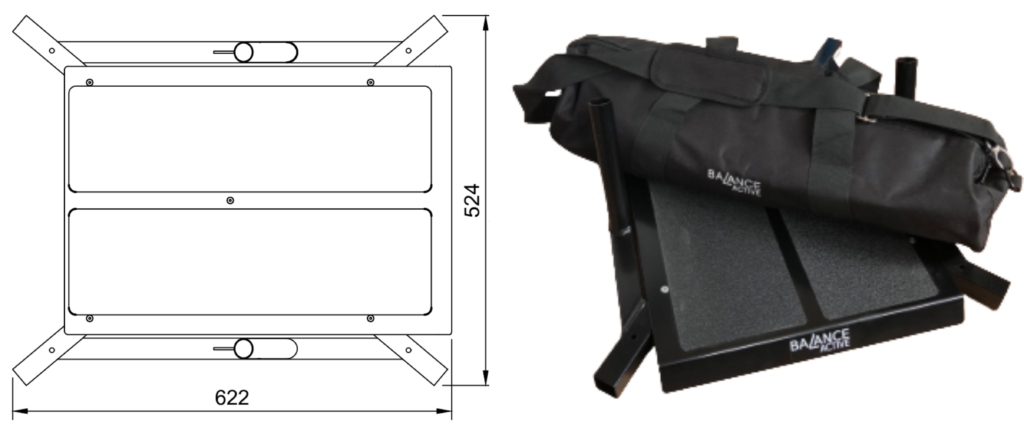
Can you pick up and carry the Balance Active® ?
Yes, Balance Active® base frame weighs 5.8Kg and the shoulder bag containing the remaining components weighs 5kg. The IFU details how the device is to be picked up and carried safely (page 6) .UKCA BA User Manual Part 2 of 2 - 4.05
Can it be used with a chair?
Yes, though not all chairs are acceptable, but use in this configuration is guided in the product’s quick reference guide (section 4) BA Quick Reference Guide - 2.02
Is it used for group classes?
Balance Active® can be used to increase safety for class participants over e.g. chairs for example for someone with dynamic balance issues, or to extend their progress e.g. to include more standing exercise in a mixed sitting & standing exercise class. All use of Balance Active must be risk assessed for each individual patient and people who are very weak or unpredictable in terms of standing ability would require additional support rather than relying on Balance Active alone to prevent a fall.
Do you have any standards/guidelines for use (e.g. standard exercises, workouts, standing tolerance durations etc.)?
Not currently, the product is only recently developed and the first of its kind. It is intended to be used as part of a tailored exercise prescription by qualified practitioners (physios, trained instructors etc).
Can you get accessory options?
Not currently, however Exyo Design Ltd is currently developing the product under government research funding (Innovate UK) so is actively producing new features which are in demand and would value your feedback in this area. Email to info@balanceactive.net .
Does it provide any lateral/rearward support?
Not currently. One of the reasons for this is that once patients are familiarised (with close supervision) with the device, Balance Active® offers greater scope of dynamic exercises with upper limbs and/or better positioning for developing improved joint strategies relative to e.g. a standing aid. However Exyo Design Ltd is currently developing the product under government research funding (Innovate UK) so is actively producing new features e.g. detachable lateral supports, which are in demand and would value your feedback in this area. Email to info@balanceactive.net
Why do the handles move a little when assembled?
The device is intended to encourage users to stand and balance actively during use. The handles, known as the ‘light touch uprights’ are designed to encourage light touch balance adjustment rather than as a crutch to rely on to complete an exercise. The slight handle movement is designed in, to act as a physical reminder of the above intended function. Nonetheless the light touch uprights provide full support to users if they need to catch themselves or rely on them at first, in order to progress to more active standing.
If you are concerned about the handle movement for your particular use scenario, contact the team at Exyo Design Ltd for approved modified handles. Email to info@balanceactive.net .